


Original Here
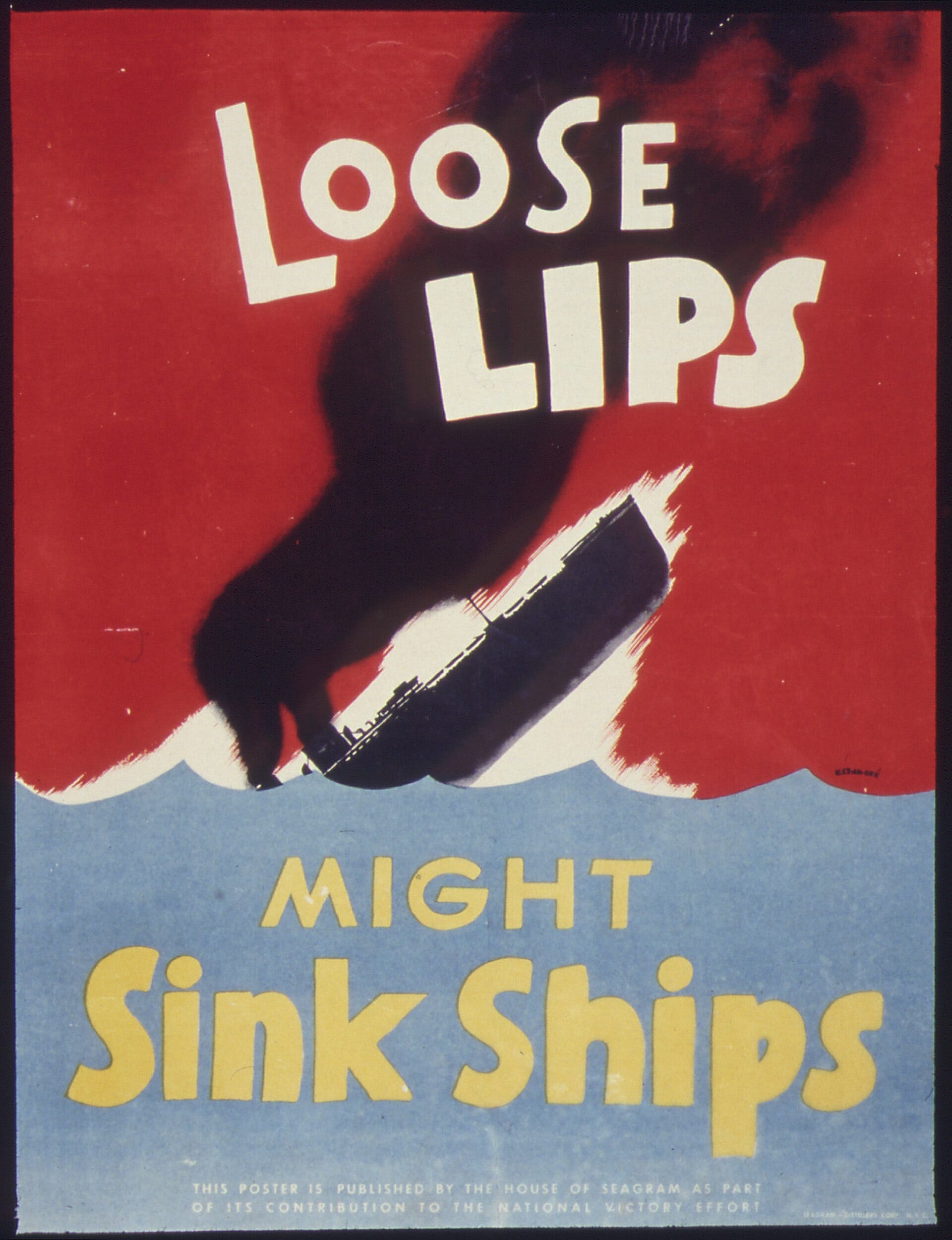
During World War II, Americans were warned that a careless conversation could expose troop movements, sailing schedules or other information useful to the enemy. “Loose Lips Might Sink Ships” was not merely a catchy poster. It communicated a simple operational truth: an adversary does not need access to the war plan if ordinary people provide enough pieces to reconstruct it.
That lesson is more important in the age of artificial intelligence.
Traditionally, we think of information leakage as the disclosure of a secret document, password or database. The human leakage vector is different. An employee mentions a delayed test at a conference. Another complains about a new supplier on LinkedIn. A third tells a friend that everyone in the office has been ordered to cancel vacation. None believes he has revealed anything sensitive. Individually, he may be right.
The problem is recombination.
Recombination occurs when an adversary collects seemingly unrelated pieces of information, identifies the people and organizations involved, places the events on a timeline and tests possible explanations for why they occurred. One inference becomes an input for the next. Artificial intelligence makes this process cheap, fast and scalable. Like earlier systems that imposed order on the vast and unstructured internet, AI can make millions of scattered human observations searchable and comprehensible.
Consider a hypothetical Navy example. One sailor tells his family that scheduled dental appointments were suddenly moved forward. Another mentions that the galley received an unusually large delivery. A spouse posts that a homecoming ceremony has been postponed. A contractor complains online about an urgent inspection of a particular weapons system. Finally, several sailors begin asking questions about phone service in the same part of the Pacific.
None has disclosed a deployment order. Nonetheless, an adversarial AI could combine those statements with weather forecasts, port activity, public photographs and historical deployment patterns. It might infer which ship is preparing to depart, roughly when it will sail and where it is likely going. The AI does not need to produce the precise classified order. It only needs to narrow the possibilities enough to help an adversary position a submarine, surveillance asset or collection team.
The same problem exists in the corporate world. Imagine that a product manager casually mentions new European labeling requirements. A recruiter advertises for Korean-speaking radio-frequency engineers. A supplier celebrates a rush order for unfamiliar battery enclosures. An executive cancels an annual conference appearance, while employees begin booking travel to the same city.
Separately, these facts are boring. Recombined, they could reveal that the company is preparing a new wireless product, working with a Korean manufacturing partner and approaching a launch or acquisition announcement. A competitor could adjust its own release schedule, approach the supplier, target the relevant employees or trade on the inferred information. Again, no one employee leaked “the secret.” The workforce leaked enough components for an AI to uncover it.
This is the problem that cognitive security and the Cognitive Security Verification Framework (CSVF) are intended to address. CSVF examines inference boundaries, semantic leakage and information reachability. In other words, it asks not only whether a system disclosed a secret word-for-word, but whether the secret became reachable through paraphrases, summaries or chains of individually harmless clues.
Employees should therefore be overly safe about what they discuss outside approved channels. This does not mean that every workplace conversation must stop. It means that people should abandon the assumption that a detail is safe merely because it appears insignificant. They do not know what other fragments an adversary already possesses, what an AI can infer from them or which harmless comment will complete the picture.
During World War II, the person listening at the next table might have been an enemy agent. Today, the listener may be a machine collecting thousands of conversations at once.
Loose lips no longer have to reveal the location of the ship. They only have to provide enough clues for an AI to find it.