
Generated by ChatGPT
Who is Linus Torvalds?
Linus Torvalds is a Finnish-American software engineer best known for creating the Linux kernel and later inventing Git, the version-control system that undergirds much of modern software development. It is impossible to calculate the value he has created for the world economy. However, his net worth is estimated at a humble $50 million, dwarfed by many of the tech billionaires who have become household names. In other words, the tech he built has yielded massive positive externalities: immense economic value that was created but not directly captured by its inventor.
What is a Positive Externality and What Are Some Examples?
A “positive externality” technology is one which generates societal benefit that exceeds the developers personal financial return. For example:
The Printing Press: while Johannes Gutenberg was the inventor of the printing press, he personally met financial ruin. The true economic value of the Press lay in the portability of language and the broader dissemination of ideas.
Linux: Torvald’s open-source operating system became the basis on which countless companies built multi-billion dollar businesses. (Alphabet’s Android operating system for example)
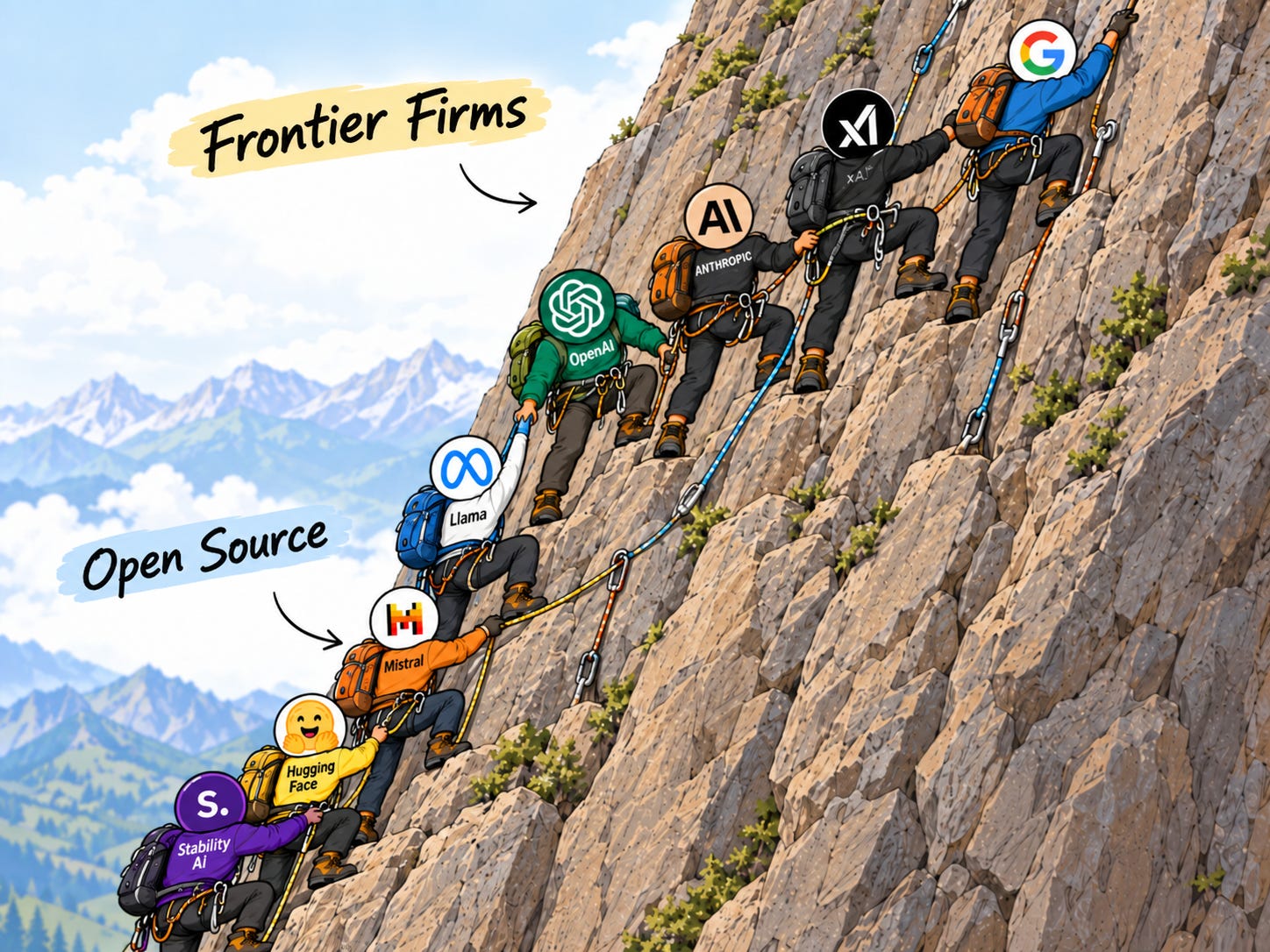
An Analogy: Frontier v. Open-Source as Rock Climber
Imagine the top AI models as a group of rock climbers.
The lead climbers (frontier AI firms like Anthropic, OpenAI, xAI, Alphabet, etc.). They are more capable at climbing and at training the AI frontier. Because they are more skilled the lead climbers establish the routes and place protection.
The followers (open-source like DeepSeek, Kimi, Ollama, etc.). These firms come later. By training their models on already established frontier models, in a process known as distillation, these firms approach the cutting edge faster than they otherwise would have given the work from the leaders.
Just as in rock climbing, sometimes lead climbers benefit from their fellow lead climbers - they use their routes or distill their models. Sometimes the followers lead in their own way as well, like when DeepSeek made massive efficiency improvements on model training in January 2025.
In this way, followers and their user base capture the benefits of the positive externalities generated by model training investments financed by frontier AI firms, their investors and the American taxpayer.
Stretching the Analogy - The AGI Thesis
Under the AGI Thesis, the race between model developers has a finish line called Artificial General Intelligence, a “singularity” where AIs will be able to improve their own capabilities without limitation and achieve something like infinite (at least for all practical purposes) growth. For the rock climbers we could imagine this AGI moment as the top of the cliff face - and the first climber to the top reaps the benefits of this infinite growth.
But what if there is no top? How do the firms provide value for customers?
By their temporary lead over the followers. Or in AI terms: the difference in capability between the frontier and its cheaper competition.
By having ascended high enough. Or in AI terms - providing significant but not frontier-level capabilities at a discount to the frontier.
High enough thesis
Many will pay a premium for the best - no questions asked. But let’s look at some numbers.
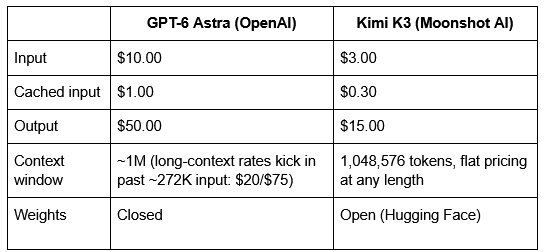
Capability: Moonshot (Alibaba’s AI arm) claims it “substantially outperformed” GPT-5.6 Sol and GPT-5.5 and performed “competitively” with Claude Fable 5. Kimi also claims that Independent testing puts it one tier below Fable 5 (Artificial Analysis Intelligence Index v4.3:).
Furthermore, Kimi’s weights are free to download on HuggingFace meaning you could run it yourself on rented infrastructure only paying the rental costs and not the above listed API costs.
This is not an advertisement for Chinese open models; it is advocacy for open-models in principle. If American / Western consumer preferences shift towards open models, American companies will be forced to shift with them. (See my America v China Article for More).
So when you pay 3x the cost for Astral (or more) what do you get? You get results which are better to the extent Astral provides better results than Fable 5. Does anyone else remember several months ago when Fable 5 (né Mythos) was apocalyptically capable? This difference is imperceptible to me. I imagine it is also imperceptible for others in 99.9% of use cases. It seems likely that open models are already high enough on the mountain, and sufficiently cheaper than their closed-model competitors, that they will inevitably capture a substantial share of the market.
Temporary-lead value thesis:
If the AGI thesis doesn’t bear fruit, frontier firms may still achieve long-term profitability by monetizing the temporary capability gap between their models and their closest open followers. Customers may be willing to pay for early access to that frontier.
On Navier-Stokes
The solution to this Millenium Prize Problem may be the best way to think about the AI frontier, the close followers and the potential value in the capability gap. But let’s consider what frontier capability actually entails. OpenAI did not arrive at this long sought-after solution by simply prompting a ChatGPT terminal to “solve Navier-Stokes”. It did so through $10s of millions in compute, and probably $10s of millions more wasted on other problems for which they didn’t find solutions. Although I am not qualified to assess, some mathematicians have claimed that this solution was not very far from the knowledge frontier and that rather than exploring a vast knowledge-space wilderness, the model actually scooped a potential near-future discovery on the backs of pre-existing, recent human labor. To summarize, OpenAI likely spent around $100 million to prove its ability to discover new knowledge. If they were to monetize this knowledge discovery capability we may think of that $100 million fixed costs as a baseline. This estimate doesn’t include every other cost that may be required to deliver results to a customer nor does it include their profit margins.
We can then ask - how else may a pharmaceutical company (for example) put $200 million to use besides a pre-FDA approval drug proposal (for example). These costs may come down with time and there will certainly be capability gap use cases, but will there be enough to justify a $2 trillion valuation? (Anthropic)
Big Frontier’s Escape Plan
If you accept my above framing you will see that frontier CEOs are in a bind. The open-source firms pose an existential threat to their business model and their investment thesis.
Below are two of the pillars of the “slowdown” proposal:
“Independent Oversight: Embedding third-party safety evaluators with deep, employee-like access inside leading AI companies to monitor risks as new models are trained.
Democratic Coordination: Establishing safety standards and agreements between democratic nations.“
Innocuous enough? But how can you embed a safety evaluator in an open model? How do you apply a safety standard to a model which can be shared as easily as a movie is streamed? You can’t, and that’s the point. You can only prevent models from being shared or hosted. They are not proposing safety standards on frontier models. They are advocating for a moratorium on open-models.
Distillation is unfair to the frontier firms. Aren’t the open-source companies stealing?
The closed-source firms distill too.
Frontier LLMs were and continue to be trained on the internet of human language - generally without compensation for the owners. LLM firms have no ground to stand on.
OpenAI took funding and developed ChatGPT as a non-profit then transitioned into a “capped-profit” structure to secure the massive capital and computing power required for advanced AI development.
But they made the investment and they did the work. Don’t they deserve to reap the economic rewards?
There is no guarantee that innovators will capture all, or even most, of the economic value they create. Linus Torvalds did not. Johannes Gutenberg did not either.
Furthermore, these investments were funded not only from private capital but also by the American taxpayer under tenuous claims of imminent AGI, catastrophic AI risk or an existential threat from geopolitical rivals.
What the Future of AI will Look Like (End on a Positive Note)
Again - AI and LLMs are a massive positive externality technology and the world economy will benefit massively. The losers will mostly be limited to Big Frontier shareholders and the American taxpayers to the extent they needlessly subsidized these firms.
How people will use AI (predictions):
The privacy-sensitive users will increasingly run small, good-enough AI on their laptops or host locally on their own infrastructure.
Others will use open-source models through third party providers.
The existence of third-party providers will create downward pressure on the prices of frontier models. Their API/subscription costs will approach those of open models.
Consumers may fall back to familiar trusted brand names like Google and familiar business models like advertising at Alphabet and Meta will win out compared to the API / subscription model.
Exponential Productivity Gains?
The future may be driven less by exponential gains in LLM capability than by the widespread diffusion of a constant productivity multiplier. If AI makes each worker six times more productive, the transformative effect comes from extending that gain from today’s relatively small group of effective users to hundreds of millions or billions of people.The positive externalities on that constant productivity gain may look something like exponential growth and the second order effects from that may be hard to predict. In other words, we may see exponential growth, but that growth won’t be based on frontier capability, it will be based on increased human agency.