


AI Could Hack Before Mythos
The breathless coverage surrounding Mythos would have you believe that machines woke up one morning in the spring of 2026 and learned to hack. They did not.
In March 2025, more than a year before the Mythos uproar, Anthropic entered Claude in a HackTheBox CTF competition pitting AI directly against human teams. Claude solved 17 of 20 challenges in 25 minutes, staying competitive with the fastest human competitors. Nobody declared the end of cybersecurity. Moreover, the more telling detail from that competition was that virtually every “human” team leaned heavily on AI tools to solve the challenges and many of those tools have existed long before the proliferation of LLMs. The most effective teams were and remain cyborg (substack) teams. The line between human and machine hacking had already blurred long ago.
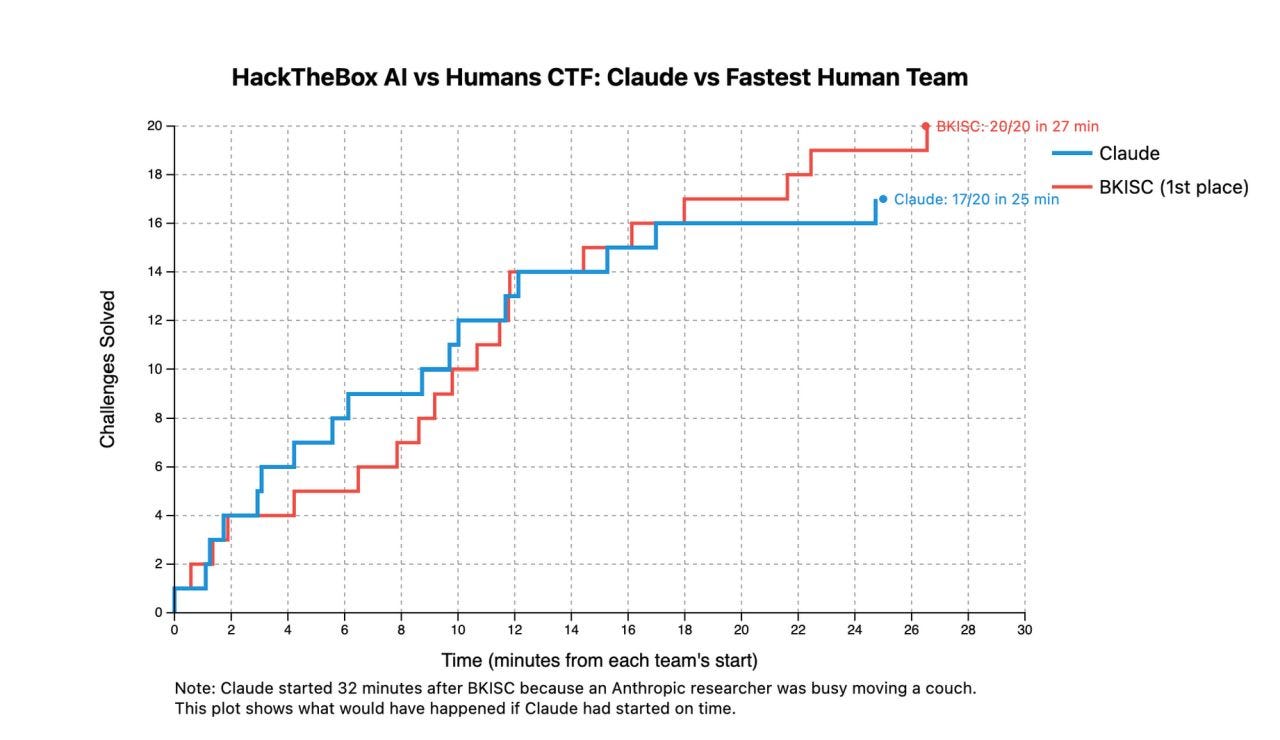
Even granting the most aggressive claims about AI hacking capability, real-world attacks are rarely the product of one person, or one agent, sitting at a terminal. They require a complex chain: access, reconnaissance, credentials, infrastructure, privilege escalation, persistence, target selection, and operational context. AI can accelerate each link in that chain but it cannot collapse the whole thing into a single prompt.
What we are watching is not a quantum leap. It is the continuation of a years-long trend toward AI-accelerated vulnerability discovery, faster exploit reasoning, and more automated attack tooling. The Mythos myth is merely marketing.
Why Proliferation Is Impossible to Stop
Think of large language models as massively lossy data compression. The dangerous output, the thing that would theoretically need to be banned, is just information formatted in a way that’s retrievable by an algorithm. A bad actor wouldn’t need access to a full frontier model; they would only need an embedding model trained on the relevant information. At the trivial limit, that could be a single paper or a single phrase. The resulting model would approach zero in size. Even setting the trivial case aside, frontier model weights are sized in the hundreds of gigabytes: small enough to mirror, compress, encrypt, torrent, and trade through ordinary internet infrastructure, or carry around in a purse.
We do have legal precedents for controlling the distribution of raw data. Pirating films is illegal, however, most people just buy the content or a streaming subscription rather than go through the hassle of learning to pirate or risk the legal consequences of being caught. The online content white market survives because the system is resilient to a high rate of defection while enough people comply that the industry remains profitable.
That model does not transfer to LLMs. Containing dangerous AI capabilities isn’t like fighting piracy; it’s more like fighting the spread of an idea where a single failure could result in a “catastrophic” outcome. Effective enforcement would require inspectability of all digital media, a moratorium on encryption, unprecedented visibility into global network traffic, and a worldwide enforcement mechanism. Even these, likely still ineffective mechanisms, would be infeasible to implement and dystopically intrusive.
Further Mechanisms of Dangerous Idea Dissemenation
Jailbreaking. It is a maxim of cybersecurity that any program of non-trivial size will contain vulnerabilities. LLM guardrails are no different. More investment in safety makes a model harder to break, but the returns diminish and no system is invulnerable. Users can bypass filters through adversarial prompting, chain prompts across turns to accumulate disallowed content, or fine-tune models with alternative system prompts. Sometimes these techniques require surprisingly little effort. Dangerous and “catastrophic” ideas are already embedded in leading models and they exist in the wild where they will be trained into future models — they are just waiting to be prompted out.
Agentic autonomy. Agents have already demonstrated the ability to route around controls by autonomously using tools like Tor or VPNs. They can run rapid, high-volume experiments no human team could match. And because model weights can be transferred in a single file, an agent needs only intermittent rather than continuous access to receive dangerous information.
Catastrophe Is Inevitable! Now What?
Catastrophe is always inevitable. The world is always changing, and technological progress produces both good and harm. The question is never whether risk exists but how to manage it.
As I see it, two paths are on the table:
1. “Constrain AI”, implement a dystopian surveillance state and kneecap human progress. This plan usually takes the form of a de facto moratorium on open-weight models. A moratorium which would, not coincidentally, protect the large-frontier model firms from their greatest competition.
2. Continue on a broadly permissive path and implement targeted mitigations from a framework of reliability engineering.
My own research and writing focuses on the second path, interventions at the margins that reduce harm without foreclosing the benefits of the technology. I haven’t seen anyone articulate a coherent middle ground beyond vague references to “sustainable methods of perpetual interference.”